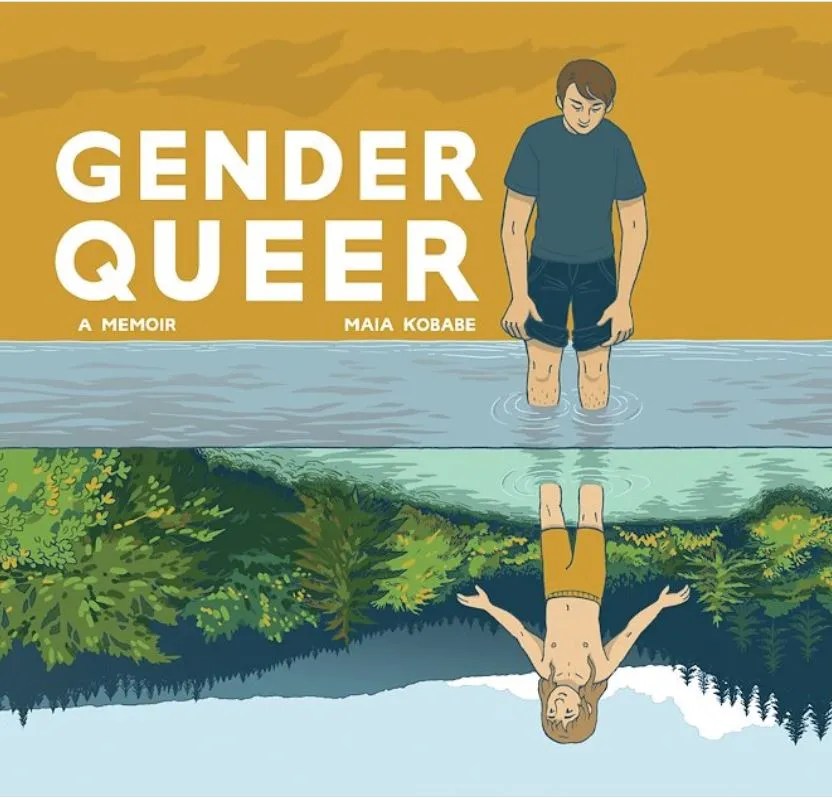
Bibliographic Information
Title: Gender Queer
Author: Maia Kobabe
Publisher: Oni Press
Copyright Date: May 28, 2019
ISBN: 978-1549304002
Genre
Memoir
Format
Graphic Novel
Print Length
240 pages
Reading Level/Interest Level
Grade 9 and up (per School Library Journal)
Awards or Honors
- Stonewall Honor – Non-fiction (2020)
- Alex Award (2020)
**note: Maia Kobabe uses the Spivak pronouns e, er, eir so will be referred to with those throughout this post
Plot Summary
Maia grew up in a supportive, unconventional household that wasn’t strict on gender rules or conformity. The bubble of this safe haven didn’t always translate to the world of school and social peer groups, though, and early on Maia found erself struggling to understand where e fit on a spectrum of sexual orientation, romantic orientation, and gender identity. With the support of friends and family, as well as learning through trial-and-error in sexual situations, some awful medical experiences, and inspiration from queer mentors around er, Maia grows in confidence about who e is, even as e continues to struggle communicating that and advocating for erself with others.
Author Background

Maia Kobabe was born and raised in Northern California and continues to live and work in the San Francisco Bay Area. E earned er MFA in Comics and worked for many years in libraries before becoming a full-time freelance author and illustrator. Er work has appeared in publications like The New Yorker and The Washington Post, several comic exhibitions, and various anthologies. Gender Queer was er first full length work, followed by Breathe: Journeys to Healthy Binding (2024) and the upcoming Saachi’s Stories, due in 2026 (Maia Kobabe, n.d.).
Critical Evaluation
The sincerity with which Maia tells er story is humbling. Er profound desire to understand erself comes through with every story and anecdote e shares. The honesty is unapologetic and I understand how it could be uncomfortable for some. The term “explicit” – as in “expressed without vagueness, implication, or ambiguity” and “open in the depiction of nudity or sexuality” (Merriam-Webster, 2024) is a fair descriptor for Gender Queer. But I don’t believe it’s gratuitous, or unnecessary. What Maia shares is necessary to understanding er journey, and for queer people who read the book to maybe see themselves, too.
Creative Use for a Library Program
Gender Queer is a great example of the graphic memoir format. A library could run a youth program similar to the assignment Maia was given and ask teens to use comic illustration and structure to share one aspect of their life story.
Speed-Round Talk
Maia is given an assignment in a course for her Master’s in Comics (yes, that’s a thing) to tell a story about one of er deepest secrets. What unfolds is a vulnerable, insightful memoir about Maia’s journey to discover er sexual orientation and gender identity.
Potential Challenge Issues and Defense Preparation
According the American Library Association, Gender Queer has been the most challenged book in the United States for three straight years – 2021, 2022, and 2023 – for “LGBTQIA+ content, claimed to be sexually explicit” (ALA, 2024). An updated book resume is posted on the ALA website to help with a defense to challenges. Because of the intense, prolonged debate about this book, I would think librarians and educators would want to get as much assistance as possible from ALA and the Office for Intellectual Freedom when attempting to defend Gender Queer.
Reason for Inclusion
As we can see with the coordinated challenges to Gender Queer, adults truly do not want young people to have access to the raw, difficult topics Kobabe brings up in the graphic novel. Which is all the more reason youth need to see them! Otherwise, Kobabe’s difficult experiences in discovering and communicating the truth of who she is will continue to happen to more young people, and perhaps with tragic results. It’s imperative for teens to have a place to ask questions, see others like them, and have a safe space to fluidly move through discovery as they work out who they are.
 To be...read/watched/played/heard
Leave a Reply